Matthias Jammot

AI & Robotics for Humans

I am a first-year PhD student at Harvard University, advised by Prof. Conor Walsh. My research focuses on foundation models of human motion, combining machine learning with physics-based reinforcement learning to decode human intent and generate adaptive control policies for real-world exosuit deployment across healthy and clinical populations. I am grateful to be supported by the Harvard Kenneth C. Griffin Fellowship, the Arthur Sachs Fulbright Scholarship, and the Jean Gaillard Memorial Fellowship.

Prior to Harvard, I worked with Prof. Christian Holz at the Sensing, Interaction & Perception Lab at ETH Zürich, combining egocentric vision and physiological signals for affect recognition and health monitoring. I hold an MEng from Imperial College London (First Class Honours), during which I spent a year in the MSc in Robotics, Systems and Control from ETH Zürich, where I worked on the design and control of exosuits.

News

Mar 2026 My team and I won the Qualcomm Prize at the MIT Media Lab's HardMode Hackathon, building BioBeats, a multimodal wearable system to play music with your body.
Feb 2026 Hosted Luxembourg Prime Minister Luc Frieden at the Harvard Biodesign Lab and presented our research.
Dec 2025 Attended NeurIPS 2025 in San Diego to present our paper egoEMOTION.
Sep 2025 Our paper egoEMOTION was accepted at NeurIPS 2025!
Jun 2025 Awarded the Arthur Sachs Fulbright Scholarship.
May 2025 Attended ICRA 2025 in Atlanta to present our paper Stillsuit.
Apr 2025 Awarded the Jean Gaillard Memorial Fellowship.
Jan 2025 Accepted to Harvard University's Engineering and Applied Sciences PhD program (3% acceptance rate)!
Oct 2024 Graduated from Imperial College London in Mechanical Engineering with First-Class Honours!
Sep 2023 Started my Master's Year Abroad at ETH Zürich.
Jun 2023 Started my summer internship at Ottobock as a researcher.
Jun 2022 Started my summer internship at Amazon as a business analyst.
Oct 2020 Started my Bachelor's degree in Mechanical Engineering at Imperial College London.

Publications

NeurIPS

egoEMOTION: Egocentric Vision and Physiological Signals for Emotion and Personality Recognition in Real-World Tasks

Matthias Jammot*, Bjoern Braun*, Paul Streli, Rafael Wampfler, and Christian Holz.

Advances in Neural Information Processing Systems (NeurIPS), 2025. (*equal contribution)
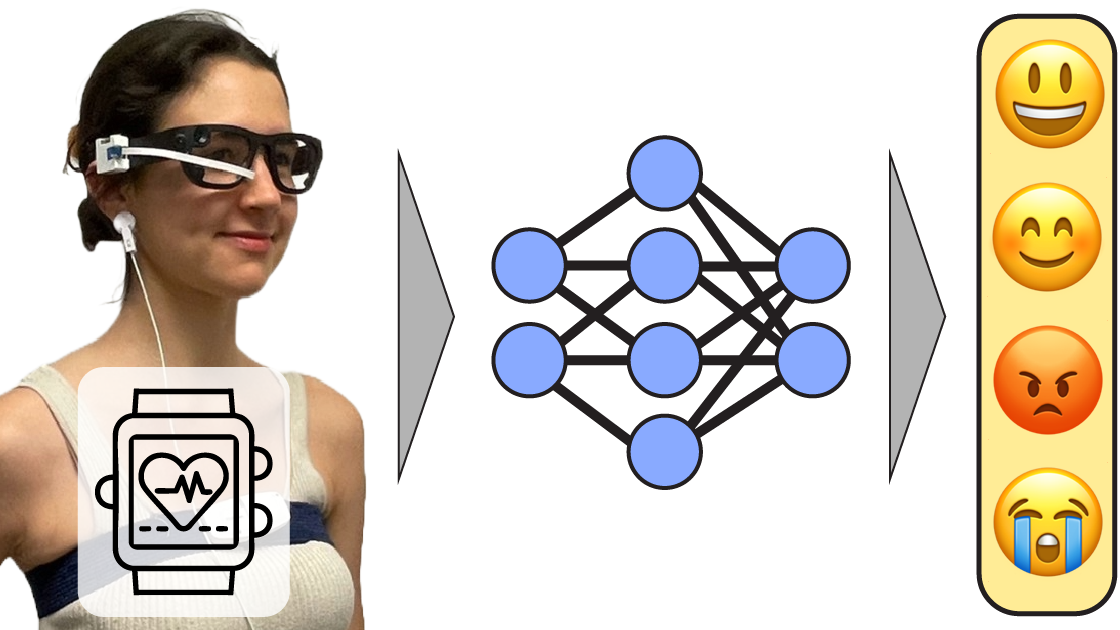
Understanding affect is central to anticipating human behavior, yet current egocentric vision benchmarks largely ignore the person’s emotional states that shape their decisions and actions. Existing tasks in egocentric perception focus on physical activities, hand-object interactions, and attention modeling—assuming neutral affect and uniform personality. This limits the ability of vision systems to capture key internal drivers of behavior. In this paper, we present egoEMOTION, the first dataset that couples egocentric visual and physiological signals with dense self-reports of emotion and personality across controlled and real-world scenarios. Our dataset includes over 50 hours of recordings from 43 participants, captured using Meta’s Project Aria glasses. Each session provides synchronized eye-tracking video, head-mounted photoplethysmography, inertial motion data, and physiological baselines for reference. Participants completed emotion-elicitation tasks and naturalistic activities while self-reporting their affective state using the Circumplex Model and Mikels’ Wheel as well as their personality via the Big Five model. We define three benchmark tasks: (1) continuous affect classification (valence, arousal, dominance); (2) discrete emotion classification; and (3) trait-level personality inference. We show that a classical learning-based method, as a simple baseline in real-world affect prediction, produces better estimates from signals captured on egocentric vision systems than processing physiological signals. Our dataset establishes emotion and personality as core dimensions in egocentric perception and opens new directions in affect-driven modeling of behavior, intent, and interaction.
ICRA

Comparative Study of Pulley and Bowden Transmissions in a Novel Cable-Driven Exosuit, the Stillsuit

Matthias Jammot, Adrian Esser, Peter Wolf, Robert Riener, Chiara Basla

IEEE International Conference on Robotics and Automation (ICRA), 2025.

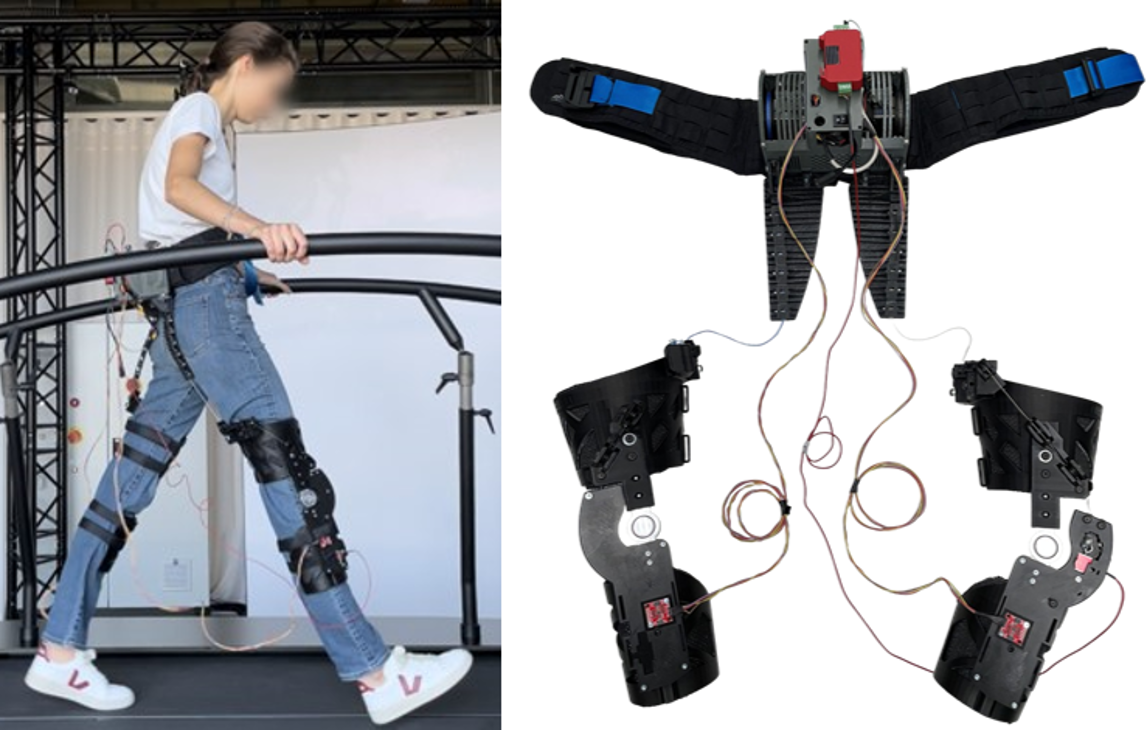
Cable-driven exosuits assist users in ambulatory activities by transmitting assistive torques from motors to the actuated joints. State-of-the-art exosuits typically use Bowden cable transmissions, albeit their limited efficiencies (40–60%) and non-linear response in curved paths. This paper evaluates the efficiency and responsiveness of a new cable-pulley transmission compared to a Bowden transmission, using both steel and Dyneema cables. The analysis includes three experiments: a test bench simulating a curved transmission path, followed by a static and dynamic experiment where six unimpaired participants donned an exosuit featuring both transmissions across the hips and knees. Our findings demonstrate that the pulley transmission consistently outperformed the Bowden’s efficiency by absolute margins of 18.77 ± 7.29% using a steel cable and by 40.60 ± 6.76% using a Dyneema cable across all experiments. Additionally, the steel cable was on average 19.19 ± 5.29% more efficient than the Dyneema cable in the pulley transmission and 41.02 ± 6.34% in the Bowden tube. These results led to the development of the Stillsuit, a novel lower-limb cable-driven exosuit that uses a pulley transmission and steel cable. The Stillsuit sets a new benchmark for exosuits with 87.56 ± 3.92% transmission efficiency, generating similar biological torques to those found in literature (16.4% and 19.0% of the biological knee and hip torques, respectively) while using smaller motors, resulting in a lighter actuation unit (1.92 kg).